Pro Tips
Good Enough Mentality
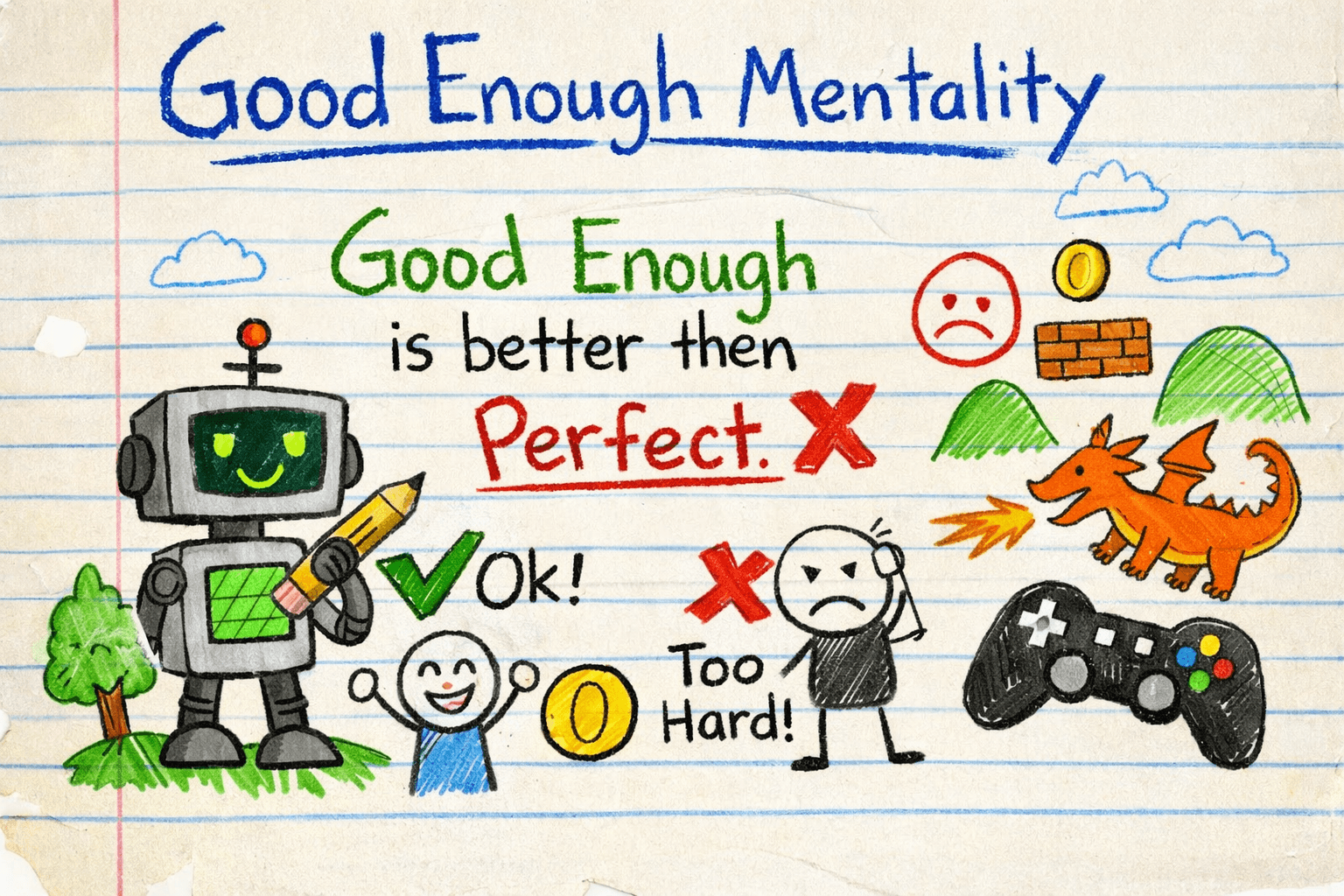
There is this obsession in game dev:
“Is it production-ready?”
“Can it replace Unity?”
“Is it scalable?”
Wrong questions.
The real question is:
Is it good enough to get you to a playable?
Because that’s where most games die anyway. Not at scale. Not at rendering pipelines.
They die before they even become real.
Lovable taught us something important
Look at Lovable.dev.
At the beginning, it was basically a gimmick.
You type → it generates something → looks okay-ish.
Not perfect. Not production-ready.
But it was good enough to:
validate ideas
build landing pages
test concepts
ship something fast
And that’s how it won.
Nobody cared that it couldn’t replace full-stack engineers.
It removed friction. That’s it.
Now apply the same lens to AI Game Dev
AI game dev is in the exact same phase right now.
Not perfect.
Not stable.
Sometimes breaks.
Sometimes does weird shit.
But…
It’s already good enough to build actual playable games.
And that changes everything.
Let’s break it down by verticals
1. Game Logic (this used to be the hardest part)
Before:
You needed real dev skills. Loops, physics, state machines.
Now:
You literally describe mechanics.
“make the character double jump”
“add enemy patrol logic”
“increase gravity after fall”
And boom — you get working logic.
Is it clean code? → no
Is it optimized? → not always
Is it usable? → yes
That’s the shift.
2. Assets (the bottleneck is gone)
Artists were always a bottleneck.
Now:
generate characters
generate backgrounds
generate UI
tweak styles instantly
With tools + platforms like Pixelfork:
upload spritesheets (idle, run, jump, attack etc.)
drop backgrounds with parallax
plug assets instantly into a playable
Are assets AAA quality? → no
Are they good enough for prototypes, playables, even soft launches? → 100% yes
3. Iteration speed (this is where AI wins HARD)
This is the real killer.
Game dev is not about building.
It’s about iteration loops.
And this is exactly where AI destroys traditional engines.
With Pixelfork:
You don’t need to prompt for every small change
You use Game Mechanics Panel
Example:
player size → 4 → 2
tree size → 1.5 → 3.5
tree count → 10,000 → 1,000
Click → Apply → Done.
No prompts.
No tokens wasted.
No back-and-forth with AI.
This alone is already a massive shift.
4. Testing & distribution (from idea → phone in minutes)
This is where it becomes real.
Pixelfork already lets you:
export Android APK
test directly on your phone
This is huge.
Because now:
idea → playable → test → iterate
No engine setup.
No build pipeline hell.
Soon → Play Store ready exports.
That’s not “future”.
That’s literally happening.
The uncomfortable truth
Most devs are waiting for:
perfect AI
perfect generation
perfect control
But by the time it’s perfect, the advantage is gone.
The winners will be the ones who use it while it’s still:
a bit broken, but already useful
Pixelfork’s angle (and why it matters)
Pixelfork.ai is not trying to be Unity.
That’s the wrong game.
The real game is:
fastest path to a playable
And that’s what matters in 2026.
Key things that actually matter:
Game Mechanics Panel → control without prompting
Reference Images → one-shot results (colors, bugs, styles)
Asset + logic + UI in one flow
Mobile-first → APK export
AI + engine tightly connected (not just a chatbox)
Most competitors are still:
“talk to AI → wait → try again”
That loop is slow. Painful. Expensive.
Pixelfork is trying to compress that loop into:
build → tweak → test → repeat (fast)
Final thought
AI Game Dev doesn’t need to replace Unity.
It doesn’t need to be perfect.
It just needs to be:
good enough to get you to something playable
Because once you have a playable:
you can test
you can validate
you can iterate
you can win
Everything else is secondary.
If you’re still waiting…
You’re not being “smart”
You’re just delaying your reps
And in game dev:
reps > tools
speed > perfection
AI already crossed the “good enough” line.
Now it’s just about who uses it first.